Outing to Diepkloof Rock Shelter World Heritage Site
By:
Prof. John Parkington, Dr Elzanne Singels & Ebbe Rabie
Date:
Sat, 17/10/2026 - 11:00 to 15:00
Branch:
Western Cape
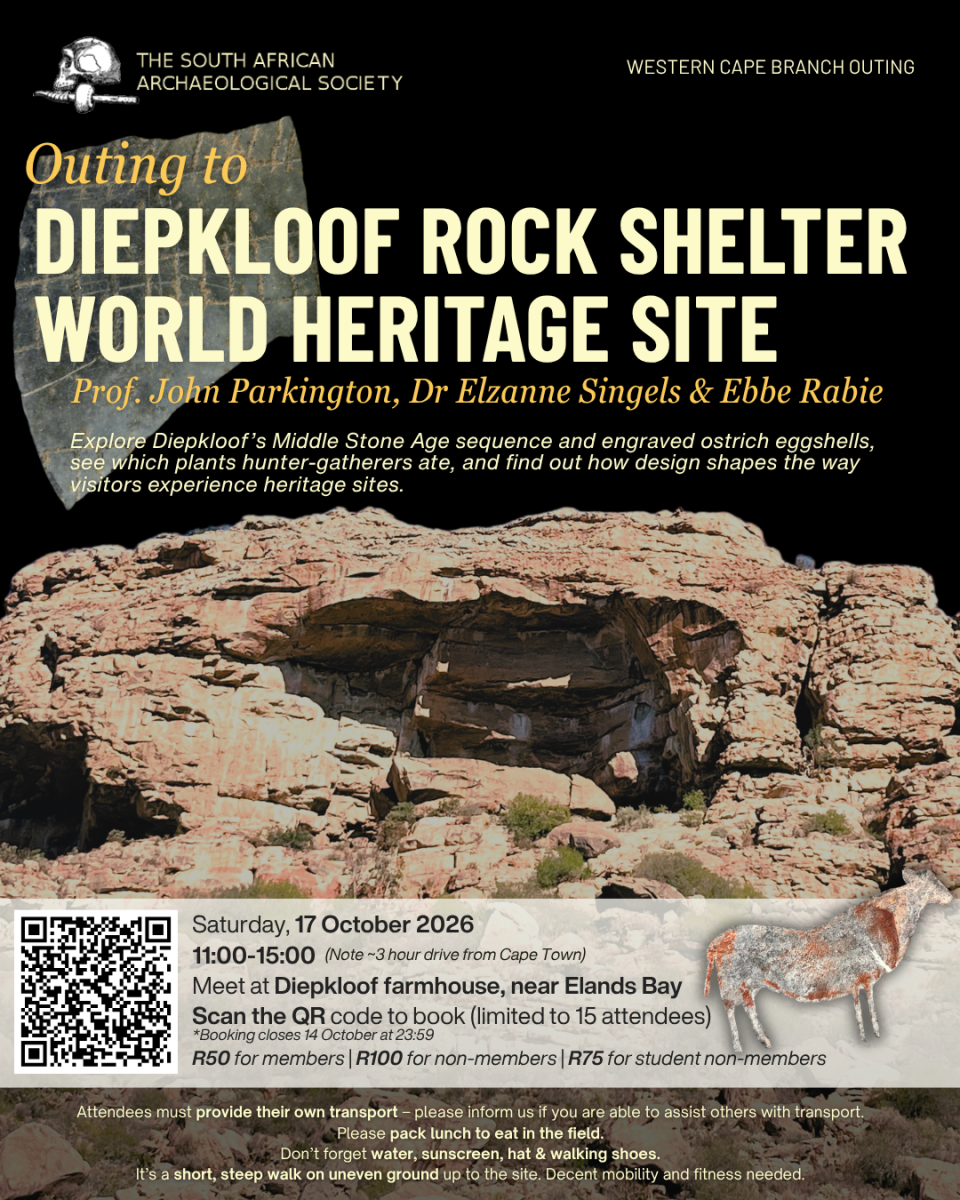
Meet at: Diepkloof Farmhouse, near Elands Bay
Booking: Click here to book your place using the Google Form
*Limited to 15 attendees, so book soon!
*Bookings close Wednesday 14 October at 23:59
Cost: R50 for members | R100 for non-members | R75 for student non-members
Please send any queries to Callan Emery at callanem@yahoo.com or WhatsApp him on: 076 399 3735
About the Outing:
Booking: Click here to book your place using the Google Form
*Limited to 15 attendees, so book soon!
*Bookings close Wednesday 14 October at 23:59
Cost: R50 for members | R100 for non-members | R75 for student non-members
Please send any queries to Callan Emery at callanem@yahoo.com or WhatsApp him on: 076 399 3735
About the Outing:
Having excavated Diepkloof himself, Prof. Parkington will take us through the site's discovery and its deep Middle Stone Age sequence, including the remarkable engraved ostrich eggshells found there. Diepkloof rock shelter was inscribed to UENSCO's World Heritage Site list in July 2024 as part of a composite property titled "The Emergence of Modern Human Behaviour: The Pleistocene Occupation Sites of South Africa", alongside the Pinnacle Point site complex at Mossel Bay and Sibhudu Cave in KwaZulu-Natal.
Dr. Elzanne Singels was privileged to analyse the archaeobotanical remains excavated at this site. Spanning the last 2000 years, these finds offer a unique glimpse into the rich relationship between the cave's inhabitants and the flora of the West Coast. Fortunately, some of the most important plant foods she identified can still be found in the veld at this time of year. Along the way to the cave, she’ll point out plants that played a key role in hunter-gatherer subsistence.
Dr. Elzanne Singels was privileged to analyse the archaeobotanical remains excavated at this site. Spanning the last 2000 years, these finds offer a unique glimpse into the rich relationship between the cave's inhabitants and the flora of the West Coast. Fortunately, some of the most important plant foods she identified can still be found in the veld at this time of year. Along the way to the cave, she’ll point out plants that played a key role in hunter-gatherer subsistence.
Ebbe Rabie’s architectural master’s thesis focused specifically on the Diepkloof Rock Shelter site in light of its possibility at the time, to become a UNESCO World Heritage Site. He explored the potential of architecture to mediate between visitors, site, and the deeply embedded heritage at the Diepkloof Rock Shelter. As a world heritage site, there is a need for Diepkloof to accommodate visitors and to effectively communicate its meaning and significance. Whatever built interventions are to be added must be thoughtfully and architecturally designed with consideration to the experience of visitors to the site. Ebbe will talk about how design plays a role in how people approach and experience historic heritage sites.
About the Hosts:
About the Hosts:
Prof. John Parkington is an Emeritus Professor and Senior Research Scholar in the Department of Archaeology at UCT. Parkington’s work examines long-term patterns of hunter-gatherer settlement and seasonal movement within the Fynbos Biome of the Western Cape. His research entails mapping, recording, sampling, and at times excavating sites across the landscape, alongside the analysis of a wide range of recovered materials. In 1973, together with Cedric Poggenpoel, he began excavating Diepkloof Rock Shelter above the Verlorenvlei. The shelter's Middle Stone Age deposits have yielded one of southern Africa's most important sequences, including more than 400 fragments of engraved ostrich eggshell dating to around 60,000 years ago.
Dr. Elzanne Singels is a botanist and archaeologist who explores the past and future relationships between plants and people. Her research examined how the ecosystems of the Cape Floristic Region shaped human evolution. She currently holds a position as a research associate in the Department of Archaeology at the University of Cape Town, alongside private consulting work that draws on her expertise.
Ebbe Rabie is a candidate architect with a diverse academic background. Before studying architecture, he previously completed a BA in Environmental & Geographical Science and History. He continued to complete his Honours in Atmospheric Science. With this multidisciplinary background he approaches the realm of architecture, bringing a rich understanding of context and place to architectural design. He is passionate about creating spaces that respond thoughtfully to their surroundings by acknowledging and accommodating the identity and meaning of a place and harmonizing landscape integration with sustainable practices.
Practical Information:
- Attendees must provide their own transport – please inform Callan (callanem@yahoo.com) if you are able to assist others with transport.
Practical Information:
- Attendees must provide their own transport – please inform Callan (callanem@yahoo.com) if you are able to assist others with transport.
- Please pack lunch to eat in the field.
- Don’t forget water, sunscreen, hat & walking shoes.
- It’s a short, steep walk on uneven ground up to the site. Decent mobility and fitness needed.
Directions:
Use the following Google Maps link for directions https://maps.app.goo.gl/oupPvAYBw8sJ9vUY8
It is close to Elands Bay above the Verlorenvlei on the Piketberg to Elands Bay road. About 3 hours (215 km) from Cape Town.