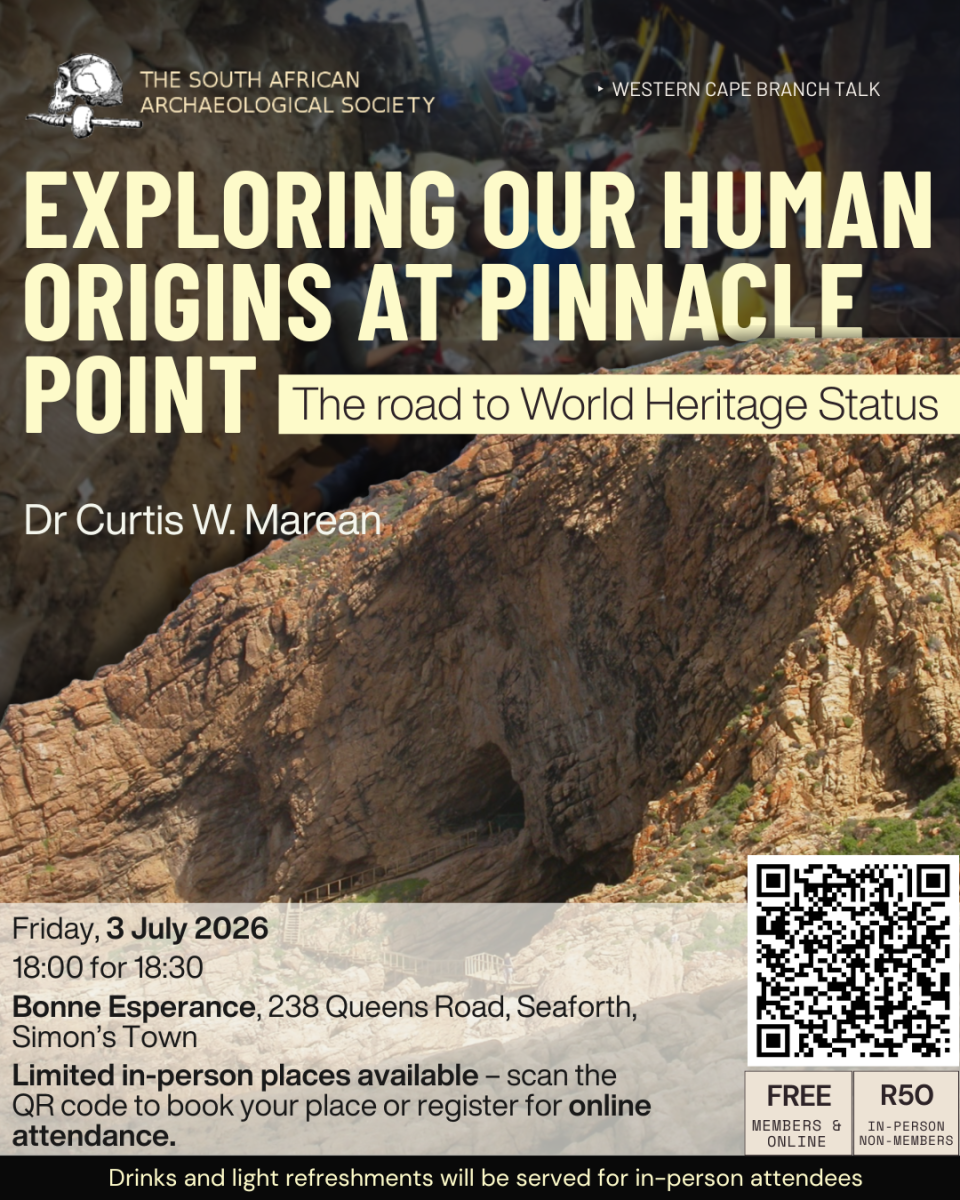
Exploring our Human Origins at Pinnacle Point: The Road to World Heritage Status
By:
Curtis Marean
Date:
Fri, 03/07/2026 - 18:00
Branch:
Western Cape
Venue: Bonne Esperance, 238 Queens Road, Seaforth, Simon's Town. Click here for a Google Maps location.
Time: 18:00 for 18:30
Charge: Free for members | R50 for non-members | Online: Free
Contact: saarchsoc.western@gmail.com for queries
The venue can only accommodate 30 guests, so please click here to RSVP using the Google Link. Note: You will also need to RSVP to receive a link to the online talk.
 About the Talk
Pinnacle Point, on the south coast of South Africa, was declared a World Heritage Site in 2024 in recognition of its significance to understanding modern human origins, particularly the origin of modern human behaviour and culture. Pinnacle Point documents the first-time people embedded their lives in the sea, experimented with advanced pyrotechnology, and invented advanced projectile weapons. This talk describes the science underlying the impact of Pinnacle Point and the state of modern human origins science. It also describes the process of becoming a World Heritage Site, and the big team effort that is required to make that happen. Finally, we explore what is next in the exciting story of unraveling the origins of modern humans and the future of research and outreach at Pinnacle Point.
About the Speaker
Curtis W. Marean (Ph.D. University of California at Berkeley 1990; Virginia M. Ullman Professor of Natural History and the Environment, Foundation Professor, Professor in the School of Human Evolution and Social Change, Arizona State University and the Institute of Human Origins; Honorary professor and International Deputy Director, African Centre for Coastal Palaeoscience, Nelson Mandela University) has research interests in human origins, the prehistory of Africa, paleoclimates and paleoenvironments, archaeological field methods, and the study of faunal remains from archaeological sites. He is particularly interested in hunter-gatherer occupation of coastal ecosystems and its impact on human origins. He has conducted research in Kenya, Tanzania, and Somalia, and since 1991 has been conducting field research in coastal South Africa. He is the principal investigator for the South African Coast Paleoclimate, Paleoenvironment, Paleoecology, Paleoanthropology (SACP4) project, now in its 26th year, based near Mossel Bay at the locality of Pinnacle Point. Pinnacle Point was declared a UNESCO World Heritage Site in 2024 for its contributions to our understanding of modern human origins and our shared long history with the sea.
Time: 18:00 for 18:30
Charge: Free for members | R50 for non-members | Online: Free
Contact: saarchsoc.western@gmail.com for queries
The venue can only accommodate 30 guests, so please click here to RSVP using the Google Link. Note: You will also need to RSVP to receive a link to the online talk.
Pinnacle Point, on the south coast of South Africa, was declared a World Heritage Site in 2024 in recognition of its significance to understanding modern human origins, particularly the origin of modern human behaviour and culture. Pinnacle Point documents the first-time people embedded their lives in the sea, experimented with advanced pyrotechnology, and invented advanced projectile weapons. This talk describes the science underlying the impact of Pinnacle Point and the state of modern human origins science. It also describes the process of becoming a World Heritage Site, and the big team effort that is required to make that happen. Finally, we explore what is next in the exciting story of unraveling the origins of modern humans and the future of research and outreach at Pinnacle Point.
About the Speaker
Curtis W. Marean (Ph.D. University of California at Berkeley 1990; Virginia M. Ullman Professor of Natural History and the Environment, Foundation Professor, Professor in the School of Human Evolution and Social Change, Arizona State University and the Institute of Human Origins; Honorary professor and International Deputy Director, African Centre for Coastal Palaeoscience, Nelson Mandela University) has research interests in human origins, the prehistory of Africa, paleoclimates and paleoenvironments, archaeological field methods, and the study of faunal remains from archaeological sites. He is particularly interested in hunter-gatherer occupation of coastal ecosystems and its impact on human origins. He has conducted research in Kenya, Tanzania, and Somalia, and since 1991 has been conducting field research in coastal South Africa. He is the principal investigator for the South African Coast Paleoclimate, Paleoenvironment, Paleoecology, Paleoanthropology (SACP4) project, now in its 26th year, based near Mossel Bay at the locality of Pinnacle Point. Pinnacle Point was declared a UNESCO World Heritage Site in 2024 for its contributions to our understanding of modern human origins and our shared long history with the sea.