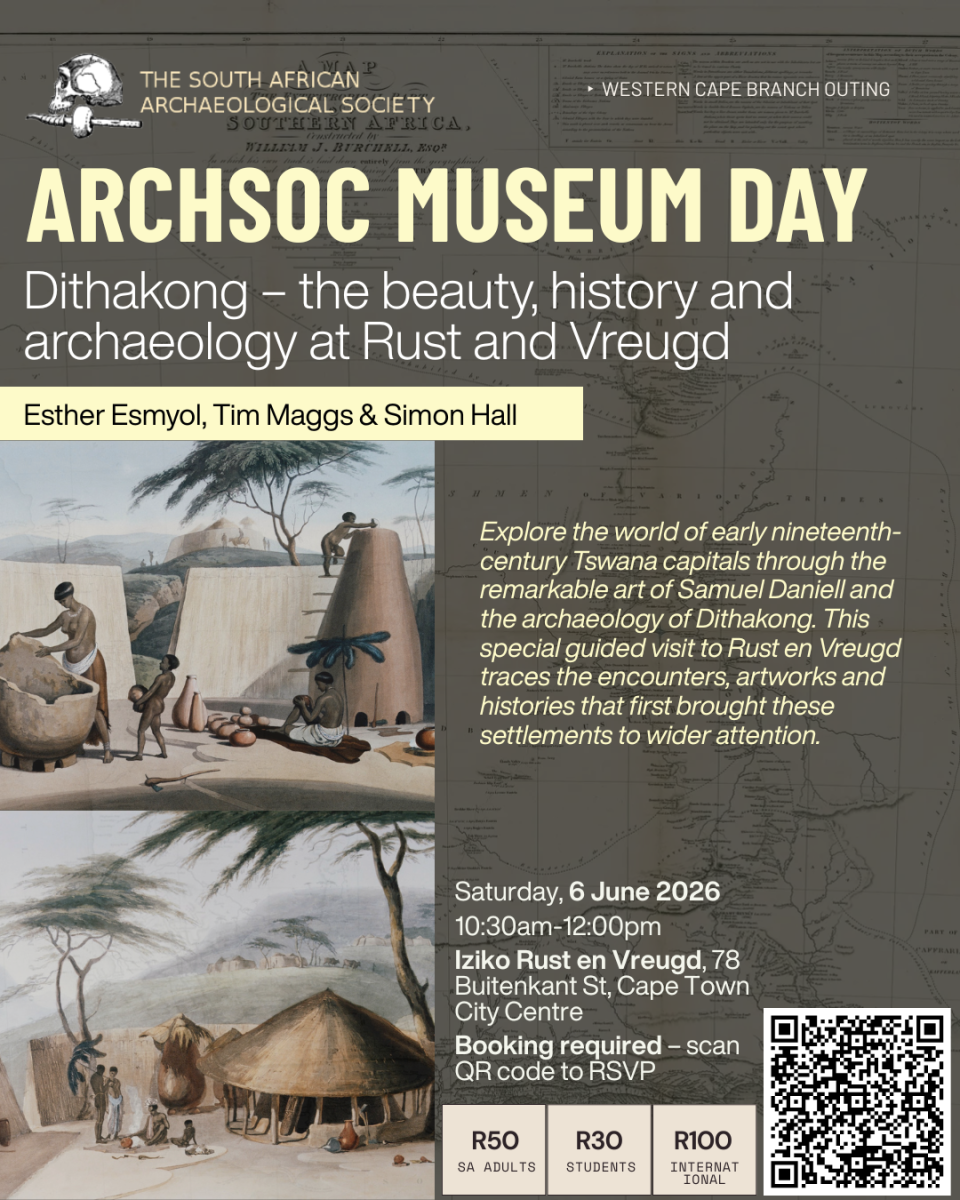
ArchSoc Museum Day: Dithakong – the beauty, history and archaeology at Rust and Vreugd
By:
Esther Esmyol, Tim Maggs & Simon Hall
Date:
Sat, 06/06/2026 - 10:30 to 12:00
Branch:
Western Cape
Venue: Iziko Rust en Vreugd, 78 Buitenkant St, Cape Town City Centre
Charge: SA Local - R50 for adults; R30 for children aged 5–17, pensioners, and students. International - R100
RSVP: Click here to reserve your palce using the Google Form. Bookings will be accepsted until 30 May
After the event, members are welcome to picnic in the Rust en Vreugd gardens, or have a light lunch at the historic Perseverance Tavern; “the oldest pub in South Africa” 1808, which is just across the street (opens 12.00, ph 082 487 8691, reservation strongly advised)
About the Event:
The first official expedition from the Cape to venture north of the Orange River reached the large Tswana town of Dithakong in 1801. The news they brought back was the first detailed information on these large settlements to reach the outside world. The exceptional British artist, Samuel Daniell, was the official artist; his works from this trip are justly famous, beautifully detailed and of great value to archaeology and anthropology. A number of his original works and prints are held in the imposing Cape Dutch house museum, Rust en Vreugd.
Esther will introduce us to Rust en Vreugd, the William Fehr Collection and its holdings of Daniell’s works of art.
The Collection reflects the outlook and aesthetics of a single collector, William Fehr (1892 – 1968) and his social context. It includes furniture, decorative arts, oils, watercolours, drawings and prints from the late seventeenth to early nineteenth centuries, covering both Dutch and British occupations of the Cape. In addition to Daniell’s art there is much else to admire at Rust en Vreugd.
Tim will outline the history of Dithakong, the 1801 expedition and others, particularly that of William Burchell in 1812.
Dithakong was the first of several large Tswana Capitals that were to astonish early nineteenth century travellers from the Cape. The various expedition records, both written and illustrated, give us the first vivid and detailed picture of life in this Tswana town which, at the time was considered to be as large as Cape Town. (Is Cape Town’s claim to be the “Mother City” really justified?). During the 1820s these large settlements were attacked and often abandoned – threatened by the Difaqane disturbances, which makes the earlier records doubly important.
Simon will summarise his work on the archaeology of Dithakong (place of ruins): Who lived there?
The settlement of Dithakong is made up of an extensive string of stone wall enclosures on a ridge immediately above the Mashoweng River, 65 kilometers northwest of present-day Kuruman. Some of the colonial traveler’s discussed by Tim visited the settlement in the early nineteenth century after it had long since been abandoned. When they asked about the identity of the previous occupants, southern Tswana informants did not seem to know or were hesitant to discuss the topic. In contrast, some archaeologists suggested that the occupants were Khoe pastoralists, based partially on the seeming unsuitability of the area for crop agriculture, and their impression that the layout of the stone wall enclosures did not fit with known Sotho/Tswana settlement patterns. However, systematic mapping of several settlement areas unequivocally established that the economic identity of the occupants were cattle and crop farmers, and that the cultural identity could be linked to Tim Maggs Type Z settlements; that in turn, can historically be linked to southern Tswana, especially Rolong communities. Subsequent excavations at one homestead have confirmed and elaborated this identity, and that the site was established from the 1600s. The location of Dithakong certainly is at the southern limits of crop production. This ecological frontier meant that Southern Tswana also lived within a cultural frontier, of hunter-gatherers and pastoralists. Some of the evidence from Dithakong reflects the complexity of this cultural mosaic, as do the rock engravings from several sites in the wider Kuruman region.
About the Hosts:
Esther Esmyol is a Curator of Social History Collections at the Iziko Museums of South Africa. Her research interests include historical Asian ceramics as well as contemporary South African production and studio pottery. In 2012 she curated a semi-permanent exhibition called Fired at the Castle of Good Hope, mainly showcasing a selection of South African ceramics from Iziko’s permanent collection. For the recent reopening of the Old Town House on Greenmarket Square she curated an exhibition called Reflections: Ceramics and circles of influence. She also works with historical collections at Iziko, such as the William Fehr Collection of art works and decorative art objects at the Castle and the Rust en Vreugd Museum.
Tim Maggs holds a BA in History 1963 (UCT), BA Hons Archaeology 1965 (UCT) and a PhD Archaeology 1974 (UCT). He was the first professional archaeologist at the Natal Museum, now the KwaZulu-Natal Museum, where he worked from 1972 to 1994. His main research interests include precolonial farming communities, rock art, Nguni and Sotho material culture, heritage management, and promotion of public archaeology. Upon his retirement in 1994, he was awarded an Honorary Professorship by UCT.
Simon Hall is an Emeritus Associate Professor at UCT. Before joining the UCT Department of Archaeology in the early 2000s, he spent 10 years at WITS, after working at the Albany Museum in Makhanda (Grahamstown) between 1980 and 1990. His research has straddled Later Stone Age, Iron Age and Historical contexts. His continuing research interests are within Iron Age studies, specifically on settlement patterns, ritual expression and the interface with the colonial world.
Additional Information:
⚠️ If booking for more than one person, please ensure the payment reflects the total combined cost for all attendees.
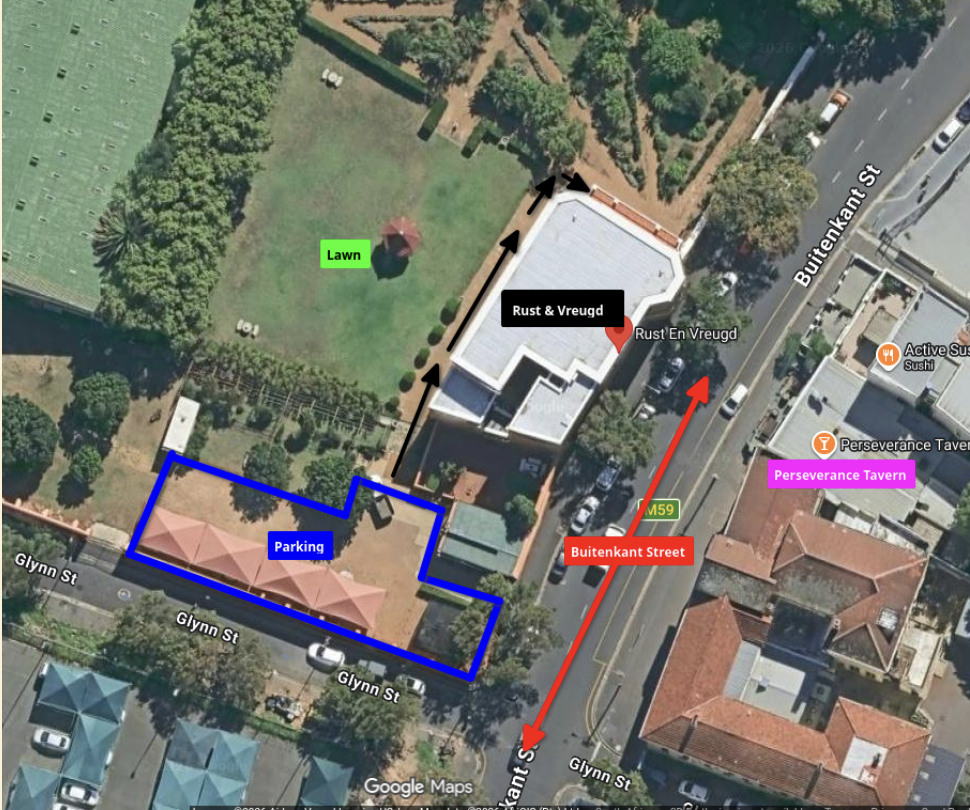
There is parking available at Rust & Vreugd with a car guard, just of Buitenkant street:
Charge: SA Local - R50 for adults; R30 for children aged 5–17, pensioners, and students. International - R100
RSVP: Click here to reserve your palce using the Google Form. Bookings will be accepsted until 30 May
After the event, members are welcome to picnic in the Rust en Vreugd gardens, or have a light lunch at the historic Perseverance Tavern; “the oldest pub in South Africa” 1808, which is just across the street (opens 12.00, ph 082 487 8691, reservation strongly advised)
About the Event:
The first official expedition from the Cape to venture north of the Orange River reached the large Tswana town of Dithakong in 1801. The news they brought back was the first detailed information on these large settlements to reach the outside world. The exceptional British artist, Samuel Daniell, was the official artist; his works from this trip are justly famous, beautifully detailed and of great value to archaeology and anthropology. A number of his original works and prints are held in the imposing Cape Dutch house museum, Rust en Vreugd.
Esther will introduce us to Rust en Vreugd, the William Fehr Collection and its holdings of Daniell’s works of art.
The Collection reflects the outlook and aesthetics of a single collector, William Fehr (1892 – 1968) and his social context. It includes furniture, decorative arts, oils, watercolours, drawings and prints from the late seventeenth to early nineteenth centuries, covering both Dutch and British occupations of the Cape. In addition to Daniell’s art there is much else to admire at Rust en Vreugd.
Tim will outline the history of Dithakong, the 1801 expedition and others, particularly that of William Burchell in 1812.
Dithakong was the first of several large Tswana Capitals that were to astonish early nineteenth century travellers from the Cape. The various expedition records, both written and illustrated, give us the first vivid and detailed picture of life in this Tswana town which, at the time was considered to be as large as Cape Town. (Is Cape Town’s claim to be the “Mother City” really justified?). During the 1820s these large settlements were attacked and often abandoned – threatened by the Difaqane disturbances, which makes the earlier records doubly important.
Simon will summarise his work on the archaeology of Dithakong (place of ruins): Who lived there?
The settlement of Dithakong is made up of an extensive string of stone wall enclosures on a ridge immediately above the Mashoweng River, 65 kilometers northwest of present-day Kuruman. Some of the colonial traveler’s discussed by Tim visited the settlement in the early nineteenth century after it had long since been abandoned. When they asked about the identity of the previous occupants, southern Tswana informants did not seem to know or were hesitant to discuss the topic. In contrast, some archaeologists suggested that the occupants were Khoe pastoralists, based partially on the seeming unsuitability of the area for crop agriculture, and their impression that the layout of the stone wall enclosures did not fit with known Sotho/Tswana settlement patterns. However, systematic mapping of several settlement areas unequivocally established that the economic identity of the occupants were cattle and crop farmers, and that the cultural identity could be linked to Tim Maggs Type Z settlements; that in turn, can historically be linked to southern Tswana, especially Rolong communities. Subsequent excavations at one homestead have confirmed and elaborated this identity, and that the site was established from the 1600s. The location of Dithakong certainly is at the southern limits of crop production. This ecological frontier meant that Southern Tswana also lived within a cultural frontier, of hunter-gatherers and pastoralists. Some of the evidence from Dithakong reflects the complexity of this cultural mosaic, as do the rock engravings from several sites in the wider Kuruman region.
About the Hosts:
Esther Esmyol is a Curator of Social History Collections at the Iziko Museums of South Africa. Her research interests include historical Asian ceramics as well as contemporary South African production and studio pottery. In 2012 she curated a semi-permanent exhibition called Fired at the Castle of Good Hope, mainly showcasing a selection of South African ceramics from Iziko’s permanent collection. For the recent reopening of the Old Town House on Greenmarket Square she curated an exhibition called Reflections: Ceramics and circles of influence. She also works with historical collections at Iziko, such as the William Fehr Collection of art works and decorative art objects at the Castle and the Rust en Vreugd Museum.
Tim Maggs holds a BA in History 1963 (UCT), BA Hons Archaeology 1965 (UCT) and a PhD Archaeology 1974 (UCT). He was the first professional archaeologist at the Natal Museum, now the KwaZulu-Natal Museum, where he worked from 1972 to 1994. His main research interests include precolonial farming communities, rock art, Nguni and Sotho material culture, heritage management, and promotion of public archaeology. Upon his retirement in 1994, he was awarded an Honorary Professorship by UCT.
Simon Hall is an Emeritus Associate Professor at UCT. Before joining the UCT Department of Archaeology in the early 2000s, he spent 10 years at WITS, after working at the Albany Museum in Makhanda (Grahamstown) between 1980 and 1990. His research has straddled Later Stone Age, Iron Age and Historical contexts. His continuing research interests are within Iron Age studies, specifically on settlement patterns, ritual expression and the interface with the colonial world.
Additional Information:
Payment via EFT:
Archaeological Society Western Cape Branch Account
NEDBANK
Account description: Savings
Account number: 2048081673
NEDBANK
Account description: Savings
Account number: 2048081673
Payment Reference: WC_InitialSurname_R&V
There is parking available at Rust & Vreugd with a car guard, just of Buitenkant street: