Annual General Meeting followed by a public lecture
By:
Prof Peter Mitchell
Date:
Thu, 09/04/2026 - 18:30
Branch:
Northern
Venue: The ORIGINS CENTRE, Yale Toad, WITS - please note that this is a different venue to our usual one
Time: 18:30 - we are starting a bit earlier to make time for the AGM which will take place before the talk. The AGM is expected to take no more than 20 minutes so the talk will start at 19:00
Charge: Free for members | R70 for non-members
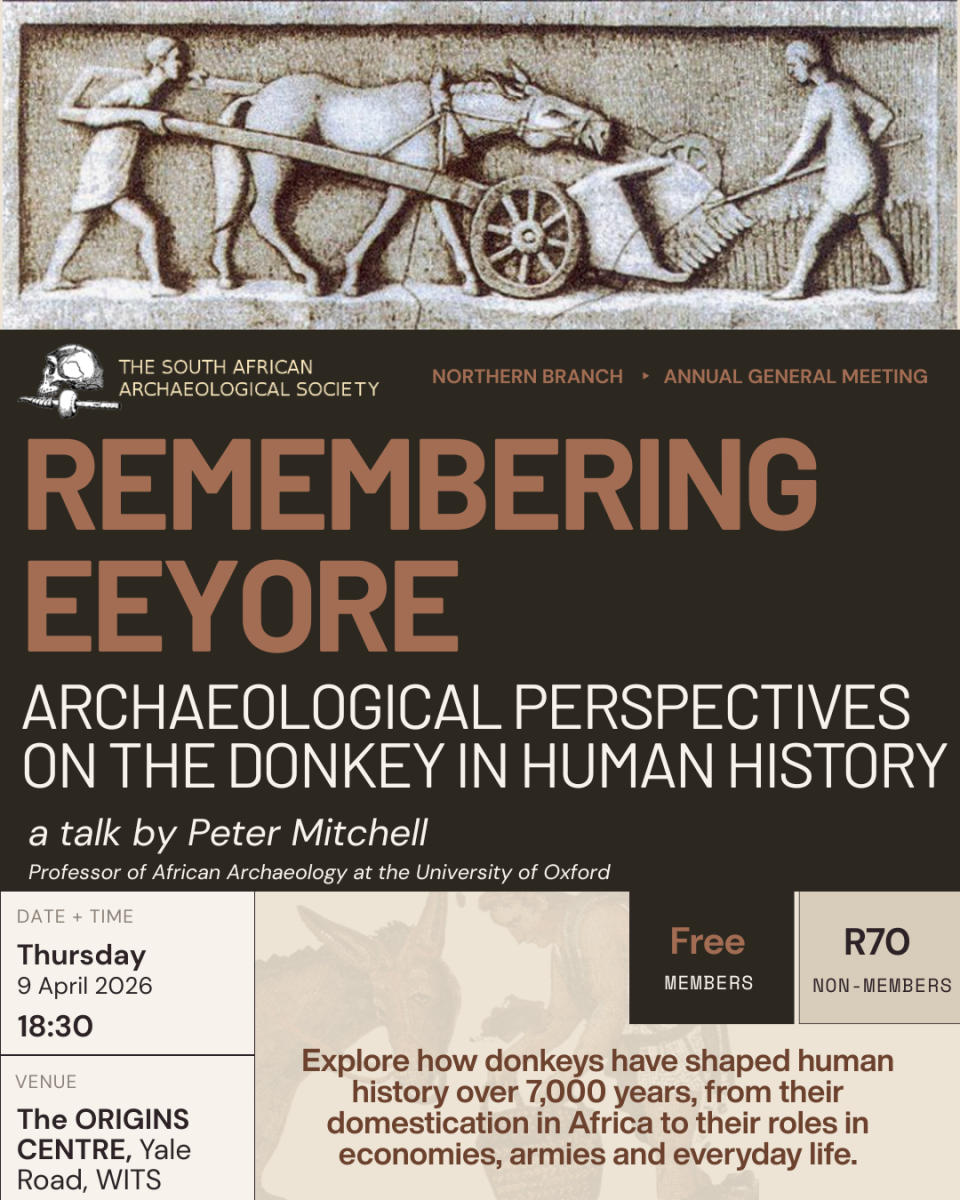
Title: REMEMBERING EEYORE: ARCHAEOLOGICAL PERSPECTIVES ON THE DONKEY IN HUMAN HISTORY
About the Talk:
Time: 18:30 - we are starting a bit earlier to make time for the AGM which will take place before the talk. The AGM is expected to take no more than 20 minutes so the talk will start at 19:00
Charge: Free for members | R70 for non-members
Title: REMEMBERING EEYORE: ARCHAEOLOGICAL PERSPECTIVES ON THE DONKEY IN HUMAN HISTORY
About the Talk:
Donkeys are the only mammal to have been uniquely domesticated within Africa and, like African archaeology in general, they have frequently been neglected by most archaeologists and archaeozoologists. As explained in more detail in The Donkey in Human History, this talk seeks to raise awareness of the historical significance of an association between people and Equus asinus that is now some 7000 years old. Having briefly considered the evidence for donkey domestication in Africa, it illustrates the historical importance of donkeys through three case studies: their association with kings and other elites in the Bronze Age of the Near East; their role in the economy and armies of the Roman world; and their significance in funding Spain’s colonial empire. It concludes by emphasising that donkeys (and mules) also provide opportunities for constructing narratives of the past that accord more agency not only to animals but also to those – often economically and politically marginalised – who employ them.
About the Speaker:
About the Speaker:
Peter Mitchell read Archaeology & Anthropology at Cambridge and then did his graduate work at Oxford under the supervision of Ray Inskeep. It was there that he first encountered southern African archaeology, writing his doctoral thesis on material from Sehonghong rockshelter in Lesotho excavated by Pat Carter. He began his own fieldwork in Lesotho in 1987 while working as a postdoctoral research fellow in Oxford and continued to excavate there until 1998. In the intervening years he both taught and held another postdoctoral fellowship at UCT, returning to Britain in 1993 where he worked briefly at the University of Wales before moving back to Oxford in 1995. There, he is both Professor of African Archaeology and Tutor and Fellow in Archaeology at St Hugh’s College, of which he is also currently the Vice-Principal. In South Africa he holds an honorary research fellowship at the Rock Art Research Institute at Wits.
He has written widely about Lesotho and of southern Africa and Africa more generally, including a synthesis of the region’s archaeology (The Archaeology of Southern Africa), a second edition of which was published by Cambridge University Press in 2024. More recently, he has investigated past human-animal relations, including horses, camels, and dogs. His book The Donkey in Human History on which this talk draws was published in 2019 and another volume, First Dogs: Hunter-Gatherers and their Canine Companions, will appear later this year.