Time: 18:30 (AGM), followed by the talk from approximately 19:00 to 20:00.
Charge: Free for members | R40 for non-members | R20 for student non-members
Drinks: Coke, Sherry/Port, Amarula: R10 per drink | Wine: R20 per glass
Cash and QR payments accepted on the day.
BURNING QUESTIONS: WOOD CHARCOAL, CARBON ISOTOPES AND SEASONALITY IN SOUTHERN AFRICAN ARCHAEOLOGY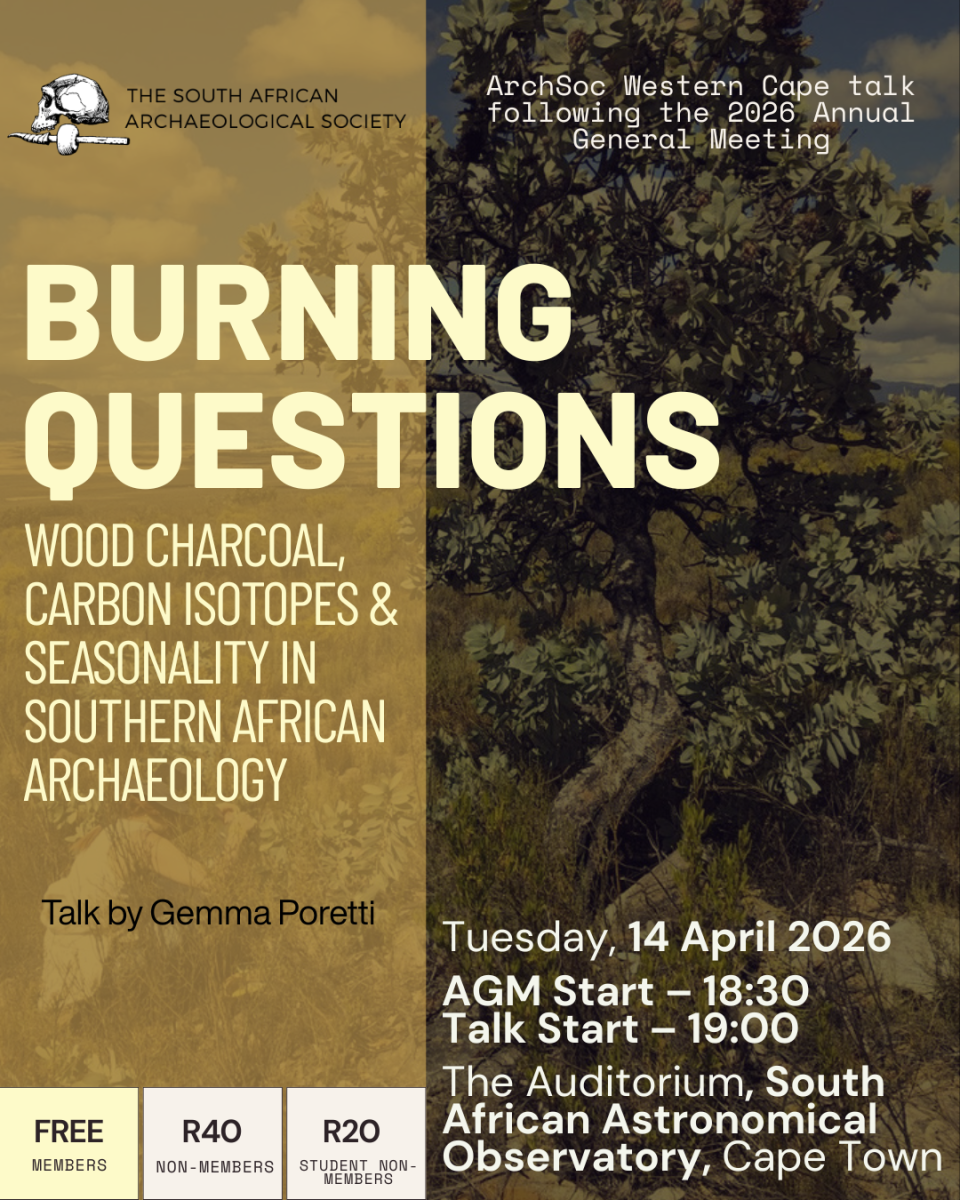
About the Talk:
Seasonality runs through many of the debates we have about past human behaviour. When did people move across the landscape? When were certain plant foods gathered, game hunted or shellfish harvested? And what were the climatic rhythms that shaped those decisions? These questions point to two intertwined but distinct dimensions of seasonality in Southern African archaeology: the timing of human activities, and the climatic reconstruction of past seasonal conditions. Both matter enormously, yet both remain frustratingly difficult to access at the resolution we would need to answer them meaningfully. One promising avenue is high-resolution stable carbon isotopes (δ¹³C) preserved in archaeological charcoal — among the most ubiquitous and durable materials recovered from South African sites, with a long history of study in the region. Charcoal analysis has long told us what plants were present; the question is whether it can also tell us what seasonal conditions those plants were experiencing as they grew. To test this, we examined modern wood and charcoal sampled across South Africa's rainfall zones, selecting two tree types with different growth strategies — Protea (angiosperm) and Podocarpus (gymnosperm) — and developed laboratory methods for extracting sub-annual isotopic signals from their growth increments. The results are promising, but the process revealed just how complex the path from 'tree ring' to climate signal can be. This talk reflects on that process, considers what the proxy can and cannot yet offer, and asks what high-resolution seasonality data could mean for how we understand past human life in Southern Africa.
About the Speaker:
Gemma Poretti holds an MPhil in Archaeology from the University of Cape Town, where her research explored rainfall seasonality during the late Pleistocene using stable carbon isotope analysis of archaeological charcoal. She currently works as a heritage practitioner with CTS Heritage in Simon's Town, and has broader interests in archaeological science, GIS, and rock art. She serves as Communications Manager for the South African Archaeological Society (ArchSoc) and is a member of the eastern Cederberg Rock Art Group (eCRAG).